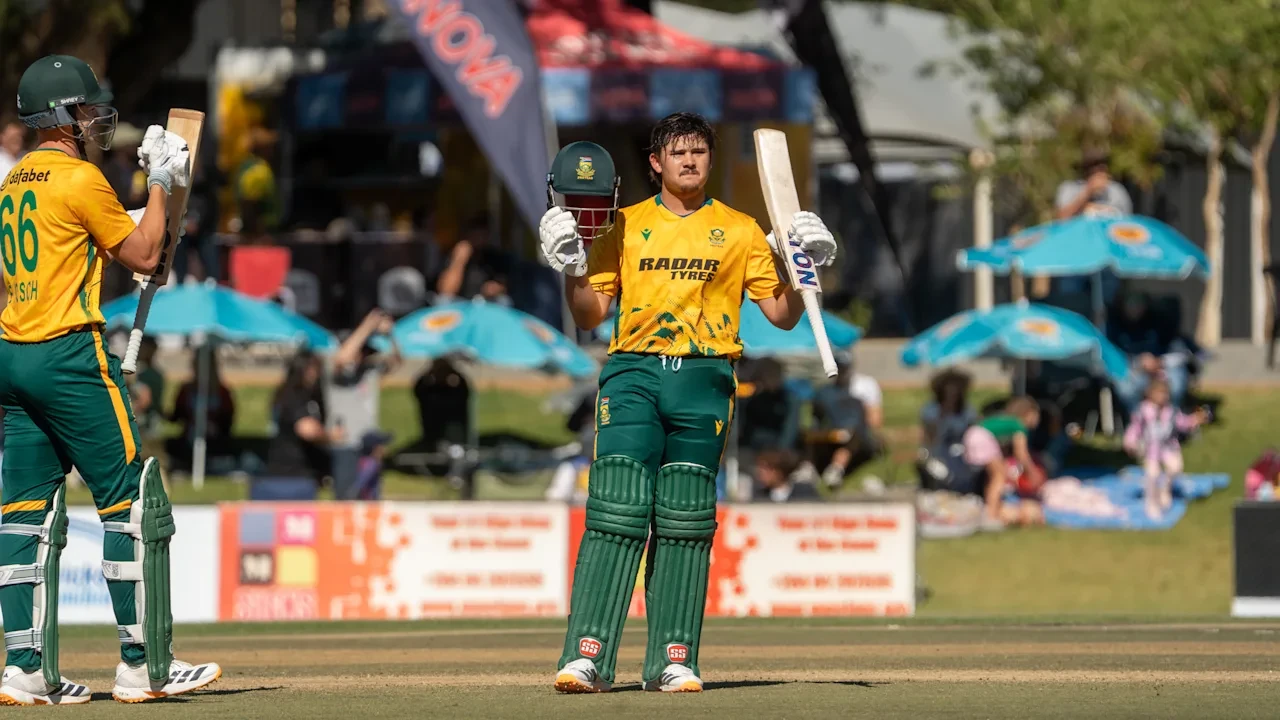
Lhuan-dre Pretorius scored his first T20 international century and gave South Africa the foundation for an 11-run victory over Namibia in Windhoek. The visitors reached 228 for four, Namibia replied with 217 for three, and South Africa secured a place in the tri-series final against Zimbabwe. The narrow margin reflected how strongly both batting groups performed.
A young opening pair controlled the first innings
Pretorius made 101 from 53 balls, striking five fours and eight sixes. His innings combined strong hitting with the patience required to stay at the crease long enough to shape the entire total. Connor Esterhuizen provided an equally aggressive partner, scoring 88 from 40 deliveries with six fours and eight sixes.
The openers added 156. That partnership was the central advantage in South Africa’s innings because it gave the middle order a clear task: preserve the pace rather than repair damage. Namibia had little chance to use early wickets to slow the game. Their bowlers were forced to search for changes while two set batters continued to find the boundary.
Pretorius reaching three figures was significant, but his contribution should be read within the partnership. Esterhuizen’s scoring prevented Namibia from concentrating every defensive option on one end. When one batter had a quieter sequence, the other could restore momentum. South Africa therefore avoided the long pauses that often follow a fast powerplay.

Namibia answered with a serious chase
A target of 229 could easily have produced a one-sided second innings. Namibia instead kept the match alive through Jan Frylinck and Louren Steenkamp. Frylinck scored 72 from 36 balls, while Steenkamp made 61 from 44 before retiring hurt. Their work ensured that the required rate remained difficult but not impossible.
Gerhard Erasmus finished unbeaten on 30 from 26 balls, and Ruben Trumpelmann added 21 from 10. Those contributions carried Namibia to 217 for three. The hosts did not lose because of a batting collapse; they were defeated by the size of South Africa’s opening partnership and a handful of overs in which the boundary flow slowed.
Nqobani Mokoena took two wickets for 43 runs and supplied South Africa with the interruptions they needed. On a day dominated by batters, a wicket was worth more than a quiet over because it required a new player to understand the surface while the required rate continued to rise.
| Team or player | Performance | Role in the match |
|---|---|---|
| South Africa | 228 for four | Set the winning target |
| Lhuan-dre Pretorius | 101 from 53 | First T20 international century |
| Connor Esterhuizen | 88 from 40 | Shared a 156-run opening stand |
| Namibia | 217 for three | Finished 11 runs short |
| Jan Frylinck | 72 from 36 | Led Namibia’s response |
The result was decided by phases, not a collapse
The scorecard contains only seven wickets across both innings. That makes the difference between the teams easier to identify. South Africa converted their best batting phase into 156 runs without losing an opener. Namibia also built substantial innings, but the retirement of Steenkamp and Mokoena’s wickets forced short resets at important moments.
In a high-scoring T20, a team can lose ground without losing a wicket. Two overs with singles and twos may add useful runs, yet the required rate can still climb beyond control. Namibia stayed close because Frylinck and Trumpelmann found boundaries, but South Africa had already created enough protection through the speed of Pretorius and Esterhuizen.
The bowlers should not be judged only by their economy figures. The surface and the quality of the hitting made containment difficult for both attacks. Mokoena’s two dismissals, the fielding that prevented extra runs and the deliveries that forced batters away from their strongest zones all contributed to the final 11-run gap.
South Africa reach the final with clear strengths and clear work
Qualification for the final against Zimbabwe confirms that South Africa handled the key pressure moment of the group stage. The opening pair gives them a powerful route to a large total, and Pretorius now has evidence that he can turn a start into a complete T20 international innings. Esterhuizen’s 88 was just as useful because it showed the threat does not depend on one batter.
The match also left a warning. Conceding 217 for three means the bowling group did not fully control the chase. Against Zimbabwe, South Africa may need earlier changes of pace, more precise boundary protection and a stronger plan when a partnership survives the powerplay. Victory should not hide those areas.
Namibia can take a different kind of confidence from the result. They stayed competitive after conceding 228 and forced the match into its closing overs. The defeat ended their route to the final, but the response demonstrated that their batting can challenge a full-member opponent. South Africa advanced; Namibia ensured they had to earn it.